Blockstream: Liquid can get a quantum fix with no deadline
A Blockstream Research paper says Liquid's hidden amounts can be upgraded against quantum inflation by soft fork, without forcing users to move coins.

Why it matters
A quantum attacker could create new coins on Liquid without anyone noticing. The researchers say data already embedded in existing coins would let validators prevent that inflation without expiring unspent coins. The proposed fix would not stop a future quantum attacker from uncovering amounts and assets hidden in past transactions.
Blockstream researchers say the hidden amounts on Liquid, the federated Bitcoin sidechain, can be protected against a future quantum attack without forcing users to move their coins before a deadline. The claim comes from a 40-page paper by Yevhen Hrubiian, Mykyta Redko and Tim Ruffing of Blockstream Research, dated September 23, which the company summarised in a blog post on November 19 and promoted again on X on November 20.
Liquid's Confidential Transactions hide each amount inside a Pedersen commitment. The paper says these commitments are only computationally binding under the discrete logarithm assumption, so "an adversary who computes a single discrete logarithm can inflate the currency as a whole, rather than merely steal individual funds." Because the commitments are perfectly hiding, "the attack even goes entirely unnoticed," the authors write. The usual remedy, they say, is to expire funds not moved by a deadline, which destroys the coins of anyone who fails to act.
A switch already in the data
The paper's answer is a switch commitment, a scheme Ruffing first described with Giulio Malavolta in a 2017 paper. It has two modes: partial verification, which matches today's Pedersen check, and a post-quantum full verification that a network can turn on later. According to the authors, Grin "is the only deployed CT network that deliberately implemented switch commitments."
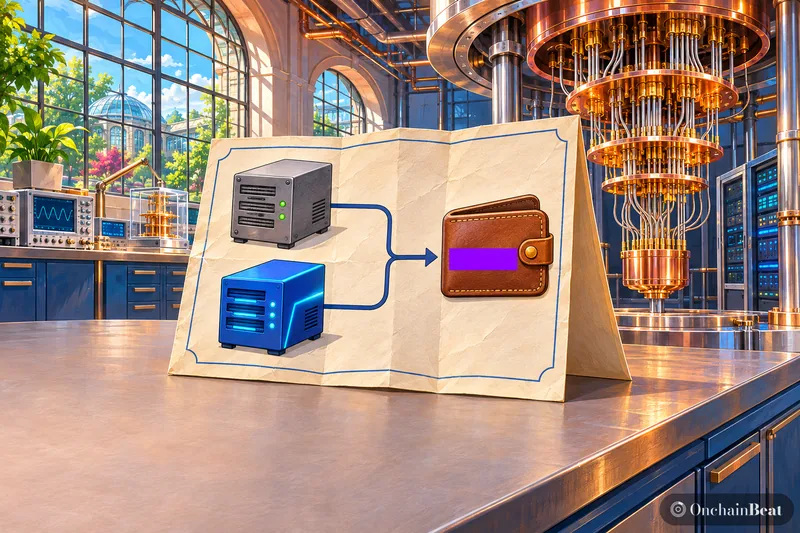
The new finding is that Liquid and Monero "already deploy a switch commitment scheme by coincidence." The ciphertext a sender puts on-chain so the recipient can learn the hidden amount can be read, together with the Pedersen commitment, as a switch commitment. In Liquid, that data sits inside each output's range proof, so existing coins already carry it.
The switch itself would be a soft fork. After it, anyone spending coins must supply extra data. "In Liquid's case, this is a rangeproof seed, allowing validators to confirm that the commitment opens to the exact amount encrypted within the rangeproof," the blog says. "Users have nothing to do today, and no coins get burned." The paper's abstract says these networks "can be upgraded to post-quantum CT schemes without expiring any user funds."
What it leaves open
The fix covers inflation, not privacy. "A quantum attacker can retroactively break ECDH and recover hidden amounts and assets," the blog says, and the paper treats replacing that key exchange with a post-quantum scheme as outside its scope. Neither the paper nor the blog gives a date or block height. The blog says the switch would come "when the threat of a CRQC becomes imminent," and neither document cites a decision by the Liquid federation. The authors also say the security theorem later stated for Grin's own scheme "does not hold, as we show," and give a weaker, computational version in its place.
How we verified Checked against the document (Iacr website (2173)), the document (Blockstream blog: Switch commitments a quantum remedy for CT) and the official announcement.
Sources
Checked by OnchainBeat · 4 links, 3 primary documents- DocumentIacr website (2173)eprint.iacr.org
- DocumentBlockstream blog: Switch commitments a quantum remedy for CTblog.blockstream.com
- StatementBlockstream post on Xx.com
- DocumentIacr website (237)eprint.iacr.org