Is Coinbase safe? What iShares' bitcoin ETF filing says
iShares Bitcoin Trust's 10-K shows Coinbase holds its coins in cold storage, with liability capped at $100M per address and insurance shared.

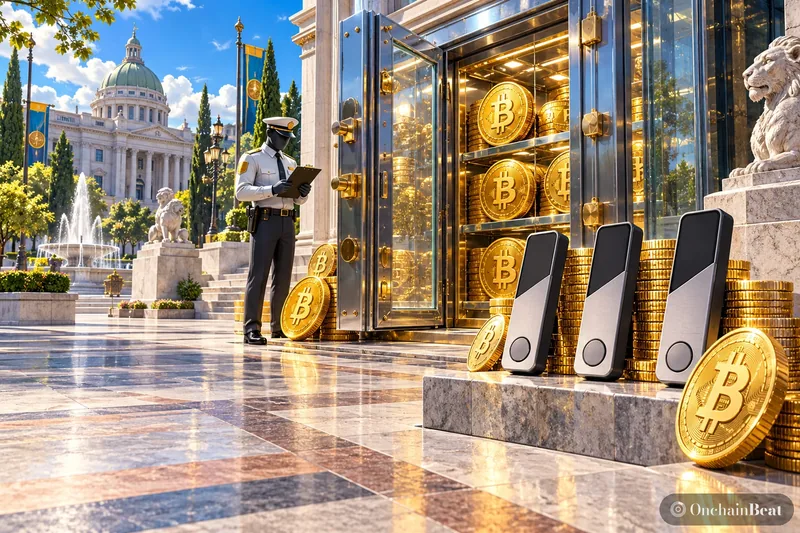
Coinbase's contract with the iShares Bitcoin Trust (IBIT) keeps the fund's bitcoin in segregated cold-storage wallets, but it also caps Coinbase's liability at $100 million per cold-storage address and relies on insurance shared among all Coinbase customers. Those terms come from the fund's 10-K filed on February 27, 2026. The theft of more than $6 billion from Binance prompted the question; the filing predates it.
How the fund's bitcoin is held
Coinbase Custody Trust Company is the fund's bitcoin custodian. Anchorage Digital Bank is named as an additional custodian, and the fund's June 30 10-Q says the sponsor has no plans to move any bitcoin there.
The 10-K says the bitcoin sits in a "Vault Balance" at blockchain addresses where only the Trust's assets are held, and that the private keys are in offline cold storage in the United States and Europe. Coinbase has represented that no single person has access to full private keys. Neither the custodian nor any other Coinbase entity may withdraw or pledge the bitcoin without the Trust's consent. The Vault Balance does carry a lien that secures short-term trade credits from a Coinbase affiliate.
Where the contract limits Coinbase
The custodian's aggregate liability is capped at the greater of two figures: $5 million or 12 months of fees, whichever is larger, and the value of the affected bitcoin or cash. Separately, liability for each cold-storage address "shall not exceed $100 million." The general cap does not apply to fraud or willful misconduct or to claims from spot trading. Coinbase also spreads bitcoin across new cold-storage wallets to keep each within its insurance limit.
On insurance, the 10-K says Coinbase Global holds a commercial crime policy covering theft, security breach or hack, and employee collusion. It is "shared among all of Coinbase's customers" and "may not be available or sufficient" to protect the Trust from all losses. The filing does not say how many addresses hold the fund's coins.
What Binance has said about its own breach
Binance co-CEO Richard Teng said on October 30 that an initial investigation suggested the incident "may have involved a compromised laptop," and that later work found "additional points of breach."
What was affected in this incident was Binance's own hot wallet. ... That delegation did not pass through our normal approval controls.
Richard Teng (@_RichardTeng), Binance co-CEO, October 30, 2026, 14:33 UTC
Teng speaks for the exchange that was hit and has a stake in how the incident is described. The FBI attributes the theft to North Korea and does not describe the method.
Coinbase's own record
In a May 2025 8-K, Coinbase said a threat actor appeared to have paid overseas support contractors or employees to collect customer data. It said the incident did not involve passwords or private keys and that the targeted personnel could not access customer funds. It estimated costs of $180 million to $400 million.
OnchainBeat's reading, offered as analysis: the filings show a contract designed around cold storage and caps, not a guarantee. They do not address the Binance attack method, and none of them was written after it.
For the theft itself, see what we know so far.
Correction (Nov 1, 2026): Was: The story included figures and quotes, among them a $387.5 million Bitget figure, an Arkham estimate of 959,000 BTC and comments attributed to two people, that could not be verified in documents. Now: Those passages were removed. The story now relies on Binance's own statements and documents. Corrections log
Related projects: Coinbase
How we verified Checked against the document (SEC filing (bit20251231_10k.htm)), the document (SEC filing (bit20260630c_10q.htm)) and the official announcement.
Sources
Checked by OnchainBeat · 5 links, 4 primary documents- DocumentSEC filing (bit20251231_10k.htm)sec.gov
- DocumentSEC filing (bit20260630c_10q.htm)sec.gov
- Statement_RichardTeng post on Xx.com
- DocumentFBI: North Korea responsible For 6 billion Binance attackfbi.gov
- DocumentSEC filing (coin-20250514.htm)sec.gov