Korea bill lets bank groups issue won stablecoins first
South Korea's draft crypto law limits early stablecoin issuance to bank-majority groups and caps exchange ownership at 20%, or 34% with FSC approval.
In brief
- Fintech and tech firms can still be the largest single shareholder in an issuer.
- Shares above the ownership cap would carry no voting rights.
- Exchanges would owe users compensation for hacks even without fault.

Why it matters
South Korea is one of the busiest crypto markets, and its exchanges are controlled by a few large shareholders. The bill decides who can issue won stablecoins and who can own the exchanges.
South Korea will at first let only consortiums majority-owned by banks issue won stablecoins, and will cap ownership of crypto exchanges at 20%, under a draft law the Financial Services Commission (FSC) presented on November 24.
The FSC discussed the bill at a meeting of its virtual asset committee chaired by FSC Chairman Lee Eog-weon. The government will push for the National Assembly to pass it quickly, the release said.
Stablecoins
The bill names stablecoins digital payment tokens. Issuers need an FSC license and equity capital of at least 5 billion won.
Ownership rules will be set by decree. At first the FSC plans to allow issuance only by consortiums in which banks hold a majority stake. Fintech and technology companies can still take part as the largest single shareholder.
Issuers must keep reserves of at least 100% of tokens outstanding with banks or similar custodians, protected if the issuer fails. They cannot pay interest to holders.
Tokens with more than 1 trillion won outstanding can be designated as significant. Their issuers face extra capital rules, and the Bank of Korea can ask for joint inspections.
Foreign issuers under adequate home supervision can operate through a local branch registered with the FSC.
Exchanges and token sales
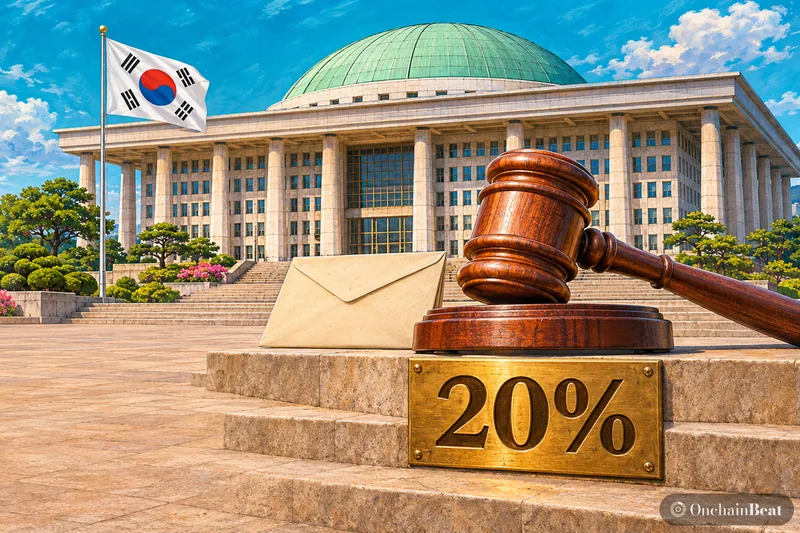
Exchanges would face a 20% ownership cap, modeled on alternative trading systems in the stock market. Holders could go up to 34% with FSC approval, and shares above the limit would carry no voting rights.
The cap would apply three years after an exchange is designated. Small and mid-sized exchanges could get up to three more years.
The bill also makes exchanges liable for hacks and outages even without fault. The FSC could fine a firm up to 10% of revenue if a breach of security duties causes an incident, according to the full release.
The bill would also end the ban on domestic token sales, or ICOs, as long as issuers disclose enough. An issuer must file a white paper with the FSC before offering tokens, covering the use of funds, supply, the project and its risks, much like a securities registration statement.
The FSC can demand corrections, and sales can start only after a review period once the filing is accepted. Exchanges must publish a listing report for each token they add.
False or missing information in these filings would bring strict liability for damages, fines and possible criminal penalties. All 28 registered Korean exchanges and custodians are already refiling under a tougher anti-money-laundering law.
By the numbers - 20%: ownership cap for crypto exchanges, up to 34% with approval - 5 billion won: minimum equity capital for a stablecoin issuer - 100%: minimum reserve backing for stablecoins - 1 trillion won: outstanding supply at which a stablecoin can be deemed significant
What this means
Banks would control who issues won stablecoins at the start, and exchange owners above 20% would have to sell down or lose votes on the excess after the grace period. None of it applies until the National Assembly passes the bill.
What we know
- The FSC presented the draft law on November 24 and will seek quick passage (FSC).
- The draft caps exchange ownership at 20%, or 34% with approval, after a three-year grace period (FSC).
What we don't know
- When the National Assembly will take up the bill, or how lawmakers may change it.
- How existing exchange shareholders above 20% would reduce their stakes.
How we verified Checked against the document (Go website (88199)) and the document (Go website (2)).
Sources
Checked by OnchainBeat · 2 links, 2 primary documents- DocumentGo website (88199)fsc.go.kr
- DocumentGo website (2)fsc.go.kr