Germany's customs crypto seizure law: what it allows
Germany's new customs law lets officials freeze crypto over €100,000 of doubtful origin for up to 180 days. A tax court decides whether it is confiscated.

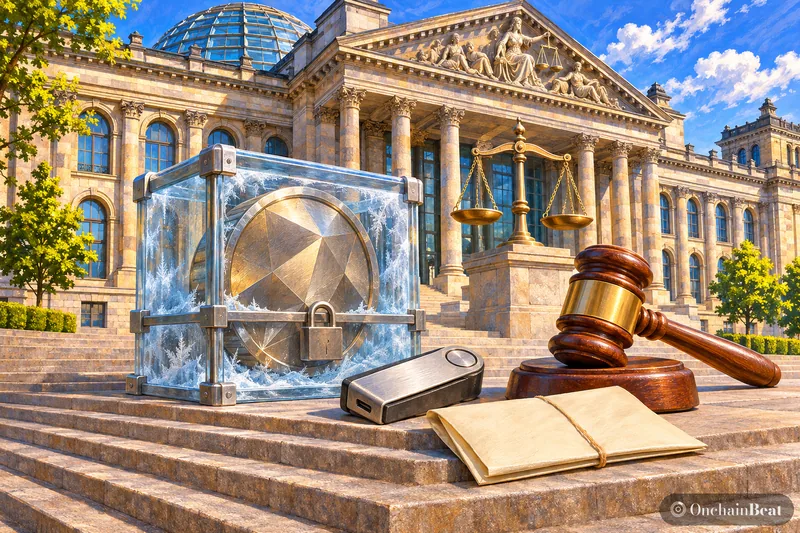
Why it matters
A tax court can order confiscation without a criminal conviction if it concludes the crypto was not lawfully acquired. Holders can decline to document where their coins came from, but anything they provide can be used in tax and criminal proceedings.
Germany's customs service will be able to freeze crypto worth more than €100,000 for up to 180 days when it has factual indications that the coins were not lawfully acquired, and to ask a tax court to confiscate them without a criminal conviction. The power is part of a customs reform bill the Bundestag passed on November 12 in the version set out in its finance committee's report. The governing CDU/CSU and SPD voted for it together with the AfD, the Left Party voted against and the Greens abstained. Under the committee text, the law takes effect on January 1, 2027.
The bill creates an administrative procedure that runs under Germany's tax code rather than criminal law. It covers "significant" assets, defined as anything worth more than €100,000, or more than €50,000 for property entered in a public register such as land, vehicles, ships and aircraft. The value can be estimated. Crypto is named directly: the definition of assets includes crypto-assets as defined in the EU's MiCA regulation and "other comparable digital representations of a value or a right." Criminal investigations take precedence; if a criminal seizure is possible, customs must inform prosecutors. That sets it apart from criminal seizures that follow arrests, such as the US Justice Department's Operation TorNado darknet case.
Asset thresholds and freeze periods
Scroll sideways for more columns
| Rule | Limit |
|---|---|
| Asset value, including crypto | More than €100,000 |
| Value of property entered in a public register | More than €50,000 |
| Initial customs freeze | Up to 30 days |
| One tax court extension at customs’ request | Another 150 days |
| Total freeze, including the extension | Up to 180 days |
Source: Bundestag website.
When customs can act
Customs can open the procedure on "factual indications" that a significant asset found within its area of responsibility is not of lawful origin. The bill says doubts are justified when, looking at all the circumstances, a lawful acquisition does not appear plausible. Officials may weigh whether the holder's income and wealth fit the asset's value, whether the source of funds can be traced without doubt, whether ownership is transparent, whether the asset turned up in a criminal case or a customs or border violation, and whether the holder's explanations proved false. Possession by people with past convictions for property crimes or other serious offenses, or by criminal organizations, is also listed.
The first freeze lasts up to 30 days. A tax court can extend it once by another 150 days at customs' request; one judge decides without a hearing, and that decision cannot be appealed. For crypto and other rights, the freeze is carried out as an attachment under the tax code's enforcement rules. Holders are asked to document where the assets came from but are not obliged to, and they must be told that anything they provide can be used in tax and criminal proceedings.
How confiscation works
If doubts remain, customs files an application with the regional tax court, with the Federal Republic of Germany as applicant. The court orders confiscation if it reaches the "free conviction, drawn from the overall result of the proceedings," that the assets are not of lawful origin; otherwise they are returned. It can decline to confiscate where that would cause undue hardship, such as threatening the holder's economic existence, and its ruling can be appealed on points of law. Once the order is final, ownership passes to the federal government.
The bill does not set rules specific to self-custody wallets or exchanges. How customs would locate and attach coins held on a hardware wallet, as opposed to an account at a regulated provider, is not spelled out in the text.
How we verified Checked against the document (Bundestag: Kw46 de finanzkriminalitaet 1231490) and the document (Bundestag website).
Sources
Checked by OnchainBeat · 2 links, 2 primary documents- DocumentBundestag: Kw46 de finanzkriminalitaet 1231490bundestag.de
- DocumentBundestag websitedserver.bundestag.de